
Access Control Planning
Door Contact, Exit Button, Fire and Tamper Inputs: What Each One Is For
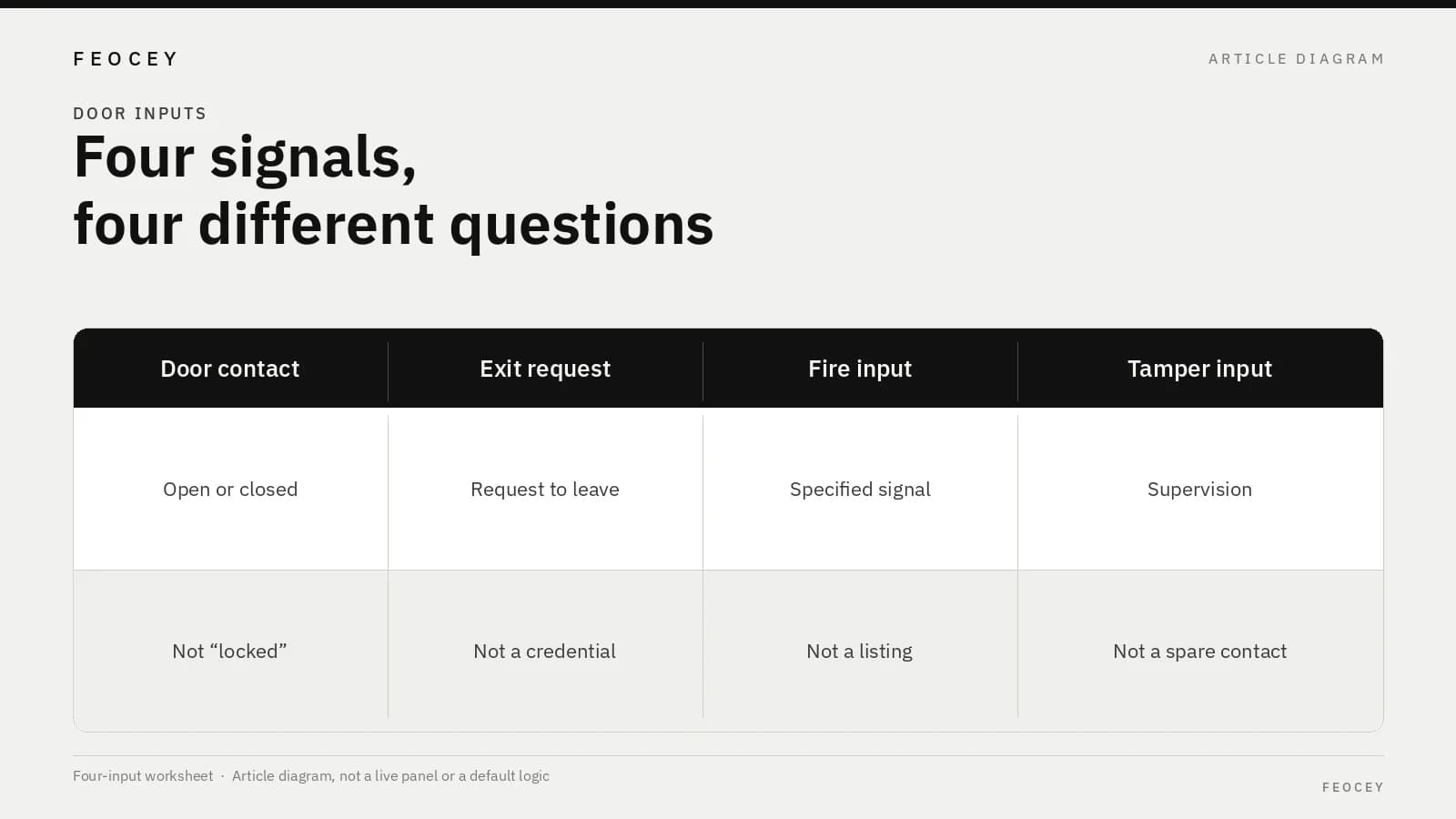
A door contact reports whether a leaf is open or closed, not whether it is locked. An exit button is not a credential, and fire or tamper inputs follow the configuration actually specified. This article separates those four signals.
Before you choose
Key takeaways.
- A door contact reports open or closed; it does not prove that a lock is secure.
- An exit button or other request-to-exit device is not a credential, and it does not by itself prove that the door has moved.
- Fire-alarm and tamper inputs follow the specified configuration; wiring a terminal is not a completed life-safety or alarm design.
Four inputs, four different questions
A door can be closed and still unlocked. A person can leave without presenting a credential. A fire signal and a tamper signal are not the same event as either of those. Access hardware often brings several inputs to one controller, which makes it tempting to treat them as slightly different versions of the same “door alarm.” They are not. This article explains what a door contact, an exit button, a fire-alarm input, and a tamper input are each for, and what none of them can prove on its own. The product fact is only that some controllers provide these terminals. The FCC4904 product page, for example, lists door-contact inputs, exit-button inputs, and fire-alarm and tamper inputs as part of a four-door arrangement, together with relay outputs. The four-door solution page lists the same groups. Those pages establish that the inputs exist as separate connections. They do not publish a default software rule for any of them. The logic you get is the logic that is specified, configured, and tested for that installation.
**A door contact**, sometimes called a door position switch, answers a physical question: is the leaf open or closed? It is usually a contact that changes state when the door moves away from the frame. A closed reading is not a locked reading. The contact does not know whether a latch is seated, whether a magnetic bond is complete, or whether a strike is secure. If a system needs a lock-status or bond-sense input, that is a different signal, and it must be specified as such. Do not assign that job to the door contact just because both wires arrive in the same cabinet.
**An exit button**, or another request-to-exit (REX) device such as a switch in egress hardware, answers a different question: is someone on the inside asking to leave, or is an egress device being used? It is not a credential, and it is not a permission record. In many systems a valid exit request is used so that a following door-open is treated as an expected departure rather than as a forced opening, and in some arrangements it is also used to release a lock. Those behaviors depend on the architecture and the configuration. They must be confirmed, not assumed from the presence of a button.
**A fire-alarm input** is a connection for a fire or life-safety signal that the project has actually specified. It is not a complete fire system, and it is not a guarantee of code compliance. What the door does with that signal—whether lock power is interrupted, whether a delay is cancelled, or whether another release path is used—has to come from the project drawings, the lock type, and the rules adopted for that building. An International Code Council article on electrical locking systems in the means of egress, discussing provisions of the 2018 International Building Code, describes several permitted system types in which power to an electrical lock is interrupted or a delay is removed when the required fire or detection system operates, or when a listed manual release is used. See Doors in the means of egress: Electrical locking systems permitted by the codes. That is an educational summary of one code edition. The adopted edition, the occupancy, and the authority having jurisdiction govern the door in front of you. Wiring a fire-alarm input on a controller does not, by itself, satisfy those rules.
**A tamper input** typically reports interference with an enclosure, a cover, or another monitored part of the device. It does not report a door position, an authorized exit, or a fire condition. What the system does with a tamper change—an event, an alarm, a shutdown, or nothing until someone enables a rule—is a configuration fact. The terminal’s existence is not the rule.
How the signals work together in ordinary use
The following sequences are teaching examples, not measured results from a named site and not a default Feocey program.
**A normal exit.** A person approaches the door from the inside and uses the specified exit device or button. If the configuration uses that request to release the lock, the lock circuit is operated by that path, not by a presented credential. The door contact then shows that the leaf opened and, later, that it closed. The exit request may also tell the system that this opening was expected. If there is no door contact, the system may have no independent way to see that the leaf actually moved. If there is a door contact but no defined exit request, a legitimate departure can look like any other opening.
**An unexpected opening.** The door contact shows the leaf open, and no valid credential and no specified exit request preceded that change. Many systems can treat that as a forced or unexpected opening, but only if those rules have been defined. The contact still only says that the door is open. It does not say who opened it, or whether the lock had been secure.
**A fire-system action and a tamper change.** A specified fire signal may require a release path that is independent of ordinary credentials. A tamper change may appear while the door is still closed. Those events should not be renamed as “door forced” or “exit” just because the wires share a controller. Keep the names of the inputs aligned with the questions they actually answer. Mechanical egress hardware can still open a door when no access credential has been used. That is often a life-safety requirement, not a fault in the access system. The door contact will still report the leaf as open. Do not treat that opening as proof that a permission was granted.
What each input can and cannot prove
One table is enough to keep the four questions apart. The “cannot prove” column is the part that is usually skipped.
Fill the last two columns from the project configuration, not from a generic memory of “how these usually work.” If the configuration is not written, write “not specified.”
| Input | Question it can answer | What a change usually indicates | What it does not, by itself, prove |
|---|---|---|---|
| Door contact | Is the leaf open or closed? | The door has moved from, or returned to, the frame | That the lock is secure, that a latch is seated, or that a permission was granted |
| Exit button or other REX device | Has an inside egress request or egress device been used? | An exit was requested, if the device and input are correctly specified | That a credential was authorized, or that the leaf has already moved |
| Fire-alarm input | Has the specified fire or life-safety signal changed state? | The configured fire signal is present or clear | That the door is already compliant, or that every lock in the building has released |
| Tamper input | Has the specified enclosure or device supervision changed? | The monitored cover or device state has changed | That the door is open, locked, or under a fire condition |
Common misunderstandings
These mistakes usually come from asking one input to answer a question it does not ask.
- Reading a closed door contact as proof that the door is locked.
- Treating an exit button as a credential, or as a substitute for a permission record.
- Assuming that every exit request also unlocks the door, or that it never does, without checking the configuration.
- Assuming that a forced-open or held-open event exists just because a contact is wired. Those derived states have to be defined in the selected system.
- Treating a fire-alarm input as automatic compliance with a fire-door or egress rule.
- Using a tamper input as a spare door contact, or a door contact as a tamper device, because a spare pair of terminals was available.
- Inferring a complete alarm program from the fact that a four-door controller lists these inputs.
How to judge an input list for one door
For each opening, write four short lines: what the door contact is monitoring, what device generates the exit request, what fire or life-safety signal, if any, is connected, and what the tamper input is supervising. Then write, for each line, what a change is supposed to cause. If you cannot name the device and the resulting action, the input is only a terminal.
Keep polarity, supervision, and normally-open or normally-closed state in the installation documents. This article does not invent a default polarity for any of the four inputs. A qualified installer should check the connections against the approved port and wiring references and the project drawings, with power removed until that check is complete.
Do not let a successful credential event stand in for these checks. A granted access, a closed contact, and a quiet alarm list can all be true at once and still leave an exit path or a fire-release path unproven. Conversely, a door that opens for egress without a card is not automatically a failed access event.
If you need to separate identity, permission, and lock output, use the workflow split already cited on the product page, and keep the authorization location as discussed in Reader or controller: allocating the access decision. This article stays with the four input questions.
Limits, short answers, and what to specify next
This article does not assign a default forced-open, held-open, fire-release, or tamper program to FCC4904 or to any other model. It does not say that every controller has this same input set. It does not treat a wired input as a completed life-safety design. The ICC article is cited as an educational discussion of one IBC edition, not as a substitute for the adopted code or for the authority having jurisdiction. Mechanical egress, fire-alarm integration, and lock behavior still have to be designed by qualified people against the drawings for that door.
**Does a closed door contact mean the door is locked?** No. The contact reports open or closed. Lock status, if it is required, is a separate fact.
**Is an exit button a credential?** No. It can request egress or mark an expected opening, depending on the configuration. It does not replace authorization for entry, and it does not by itself prove that the leaf has moved.
**Does connecting a fire-alarm input make the door fire-compliant?** No. The input is only a specified connection. Release behavior, lock type, mechanical egress, and the adopted rules still have to be confirmed for that opening.
**What should be written before the door is treated as complete?** The device at each of the four inputs, the action a change is supposed to cause, and the document that defines that action. If one of those is missing, the signal has been named but not yet specified.
Source references
Feocey: Reader or controller: allocating the access decision ↗Feocey four-door access control site survey checklist ↗Feocey: Planning access control for an office building ↗Put the guide to work
Find the reference for your model.
Compare each device with your requirements. Confirm configuration and compatibility for the complete installation.
Discuss your project ↗