
Access Control Planning
Reader or Controller: Allocating the Access Decision
In access control, the access decision—granting or denying entry—can reside in the reader or the controller. This article clarifies the roles of each component, the implications for system design, and how to plan a reliable installation using approved Feocey hardware references.
Before you choose
Three decisions to start with.
- The access decision can be in the reader or controller, but must be explicitly planned.
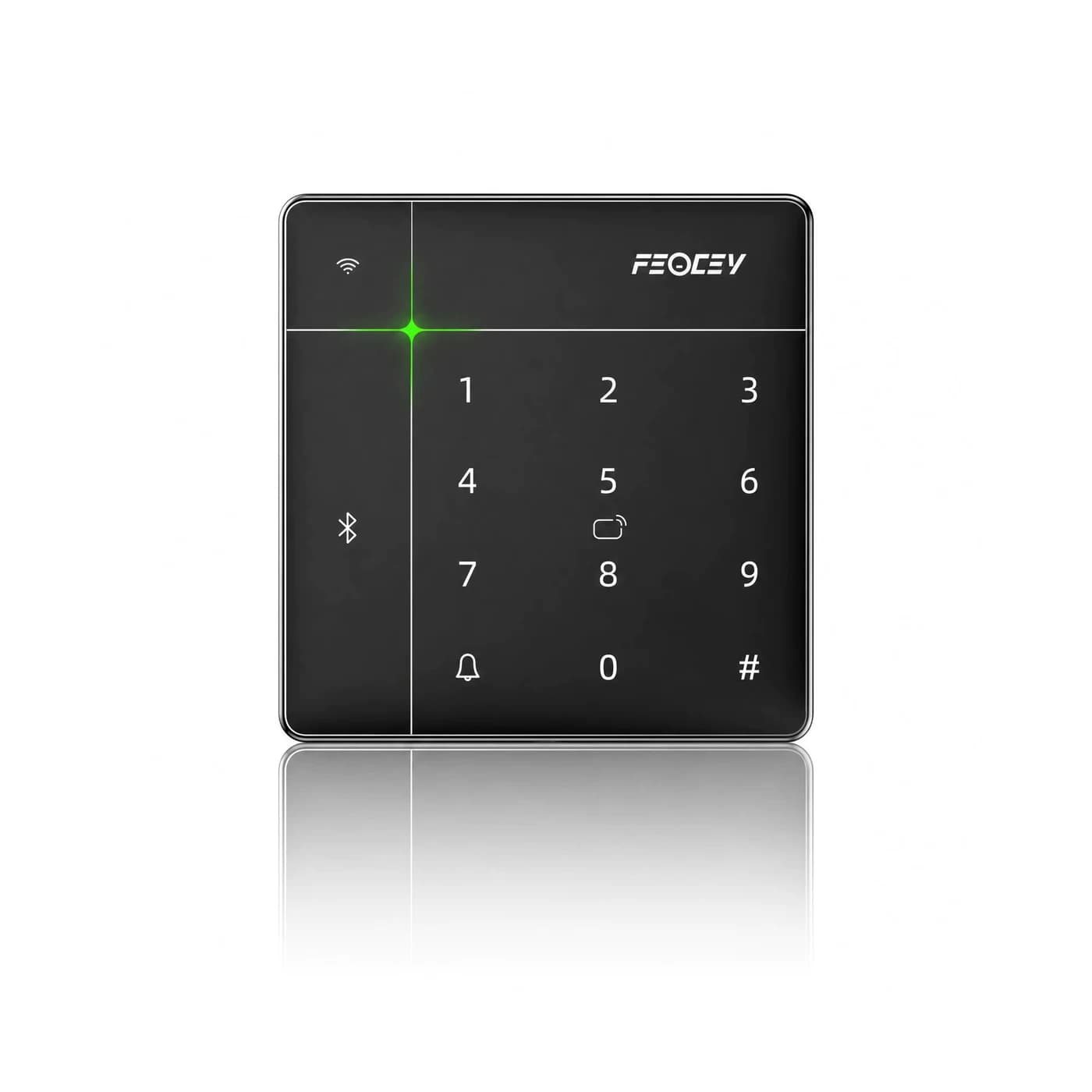
- FCS525 outputs Wiegand, typically requiring a controller for decisions.
- FCC4904 is a four-door controller that can make centralized decisions.
- Always separate reader power from lock power and verify relay ratings.
- Test offline behavior and permission changes before rollout.
Understanding the Access Decision
In any access control system, the access decision is the logical step that determines whether a presented credential should result in a door unlock. This decision can be made by the reader itself or by a separate controller. The choice affects system architecture, scalability, and security.
The approved source library distinguishes between reading a credential and deciding whether a person may enter. For example, the FCS525 reader outputs Wiegand 26/34, while the FCC4904 controller has RS485 reader connections. These are different interfaces, and the decision location must be explicitly planned.
- The access decision is separate from credential reading.
- Readers and controllers have distinct roles.
- Interface compatibility does not imply decision allocation.
Reader-Based Decision Making
Some readers, often called standalone or intelligent readers, can store a local database of authorized credentials and make access decisions without a central controller. This approach can simplify wiring and reduce dependency on a network connection.
However, the approved sources do not provide specific details on standalone decision capabilities for FCS525. The FCS525 manual describes Wiegand output, which typically sends credential data to a controller for decision. Therefore, for FCS525, the decision is likely made by a controller, not the reader itself.
- Standalone readers may store credentials locally.
- FCS525 outputs Wiegand, suggesting controller-based decision.
- Always confirm decision location with supplier documentation.
Controller-Based Decision Making
In many systems, a central controller (like FCC4904) receives credential data from readers, checks it against a permission database, and then activates the door lock. This centralized approach allows for easier management of multiple doors and users.
The FCC4904 is described as a four-door controller with RS485 reader connections. It organizes reader, lock, door-contact, and exit connections. The controller likely makes the access decision based on its configuration and connected host system.
When using a controller, the reader's role is limited to capturing the credential and transmitting it. The controller then compares the credential against its rules and sends a signal to the lock relay.
- Controllers centralize permission management.
- FCC4904 manages multiple doors and connections.
- Reader sends data; controller decides and acts.
Implications for System Design
Choosing where the access decision resides affects wiring, power, and network requirements. If the decision is in the controller, the reader-controller communication must be reliable. If the decision is in the reader, the reader must have sufficient memory and processing power.
The approved sources emphasize separating reader power from lock power and verifying relay contact ratings. For example, FCS525 has a 12V DC supply and a 30V/1A relay contact rating; the relay rating is not an instruction to power the terminal at 30V.
Additionally, offline behavior must be considered. If the controller is offline, can the reader still make decisions? The sources recommend testing offline behavior and recovery without granting withdrawn access.
- Decision location impacts wiring and power design.
- Separate reader and lock power circuits.
- Test offline behavior and recovery.
Planning Questions for Your Installation
To allocate the access decision correctly, answer these questions:
1. Which component stores the authorized credential list?
2. Which component compares the presented credential to the list?
3. Which component activates the door lock?
4. What happens if the connection between reader and controller is lost?
5. How are permission changes propagated to the decision-making component?
The approved sources provide checklists for testing valid, invalid, and expired credentials, and verifying that a command for one door does not affect another. Use these as a basis for acceptance testing.
- Identify credential storage location.
- Determine decision-making component.
- Plan for network interruptions.
- Test permission changes thoroughly.
Using Approved Feocey Hardware
For a controller-based decision, FCC4904 can manage up to four doors with RS485 readers. For reader output, FCS525 provides Wiegand 26/34. However, these are not directly compatible without proper interface conversion, as noted in the source 'Can a Wiegand reader connect to an RS485 controller?'. Always confirm the complete integration path with Feocey.
When planning, refer to the four-door access control site survey checklist and the pilot acceptance checklist to ensure all aspects are covered.
- FCC4904 for centralized control.
- FCS525 for Wiegand output.
- Confirm compatibility before ordering.
- Use checklists for planning and acceptance.
Source references
FCS525 Product Manual, pp. 6 and 9 ↗FCC4904 Port Description, pp. 1–2 ↗Put the guide to work
Find the reference for your model.
Compare each device with your requirements. Confirm configuration and compatibility for the complete installation.
FCS525 →
Keypad & IC Card Reader
Ask about FCS525 ↗FCC4904 →
Access controller
Ask about FCC4904 ↗