
Access Control Planning
Fail-Safe and Fail-Secure: What a Door Lock Does When Power Is Lost
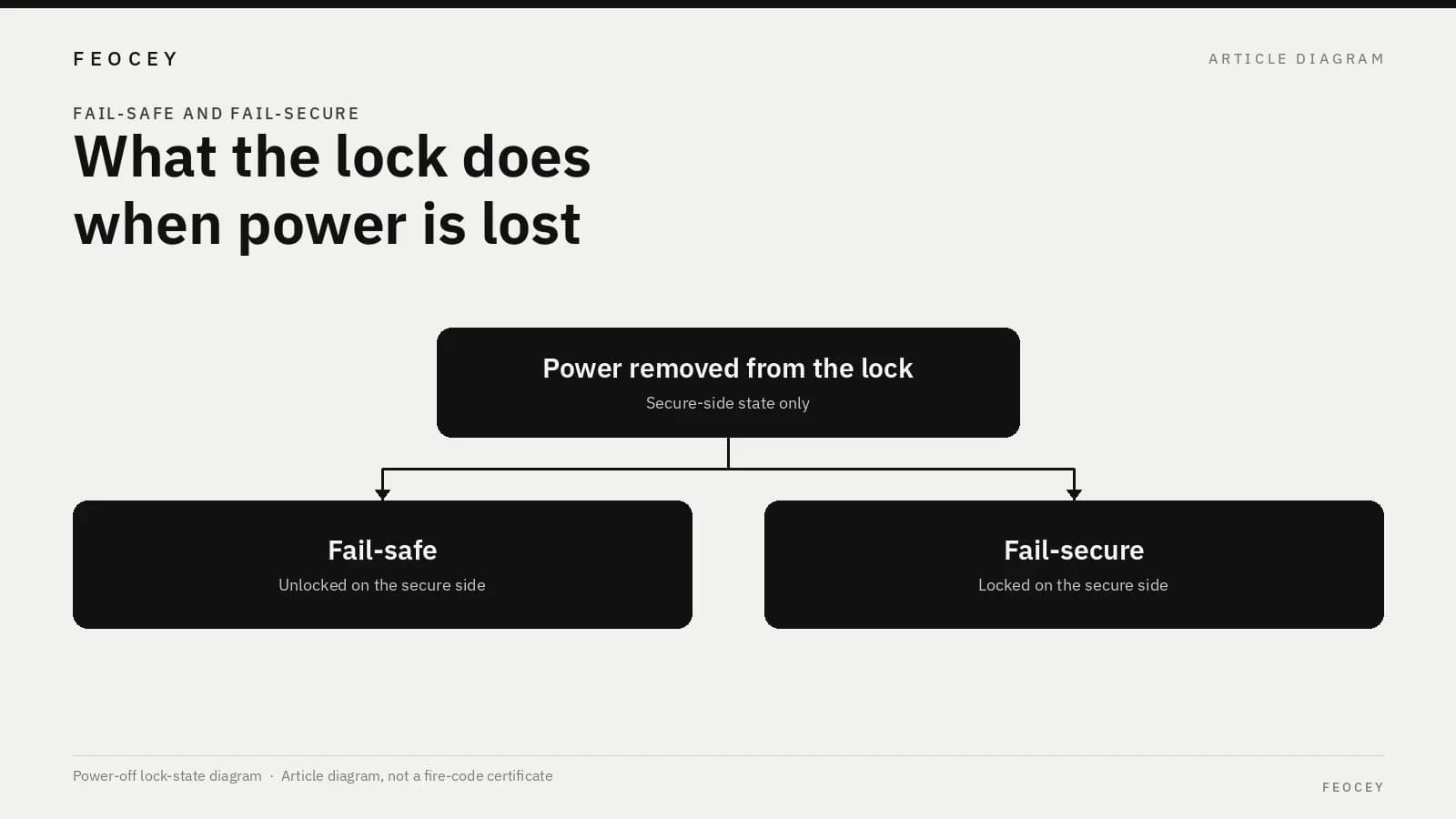
Fail-safe and fail-secure describe the secure-side state of a lock when power is removed. They do not, by themselves, make a door fire-compliant or trap people inside. This article separates power-loss behavior from mechanical egress, fire signals, and lock power.
Before you choose
Key takeaways.
- Fail-safe means the secure side is unlocked when power is removed; fail-secure means it remains locked. The words are not a life-safety approval or a claim that people are trapped.
- Lock type, mechanical egress, fire-signal release, and which circuit actually loses power are separate facts from the fail-mode label.
- Do not assign a fail mode to a controller as if the controller were the lock, and do not treat a label as a listing or a code result.
What the two terms actually say
When power to a lock is removed, the secure side of the door is either unlocked or still locked. That single fact is what fail-safe and fail-secure describe. The English names are easy to reverse, and they are often asked to do work they cannot do: prove fire-code compliance, prove that occupants cannot leave, or stand in for a complete lock-power design. This article keeps the power-loss state in its own place, then shows how it differs from mechanical egress, fire-alarm release, lock type, and the supply circuit.
It is a knowledge explanation, not a door schedule and not a claim about a default mode on any named controller. A qualified installer should confirm the hardware actually supplied, against the project drawings and the rules adopted for that building. This is not a live-wiring procedure.
Allegion’s codes-and-hardware education article states the basics in two lines. Fail-safe products are unlocked when power is removed; power is applied to lock the door. Fail-secure products are locked when power is removed; power is applied to unlock the door. The terms refer to the status of the secure side—the key side, or outside—of the door. Most products, the same article notes, still provide free egress from the inside, whether they are fail-safe or fail-secure. See Decoded: Fail Safe vs. Fail Secure.
That last point is the one that is most often missed. Fail-secure does not automatically mean that people are trapped. On many electric strikes and electrified locksets, the mechanical lever, exit device, or other egress hardware still lets a person leave, because that hardware works independently of the electric function. Fail-safe does not automatically mean that the door is the safe or legal choice. It only means that, with power gone, the secure side is unlocked. Whether that is acceptable, or even permitted, depends on the opening, the lock type, and the adopted rules.
The names cause trouble because “safe” sounds like a life-safety approval and “secure” sounds like an absolute lock-in. They are labels for a power-off state, not a completed risk assessment.
Lock type changes what those labels can mean
The same words do not describe every lock in the same way. Allegion’s article is useful here as manufacturer education, not as a substitute for the datasheet in your package.
An electric strike can often be specified as fail-safe or fail-secure. In the fail-secure case, removing power leaves the keeper secure; power is applied when access from the outside is allowed. In the fail-safe case, removing power frees the keeper. Because the lockset or exit device on the door can still retract its own latch, a person can often leave even when the strike is fail-secure. Allegion also notes that, for electric strikes on fire-rated doors, fail-secure strikes are used so that the door can keep the positive latching and the listings associated with NFPA 80, the Standard for Fire Doors and Other Opening Protectives. That is Allegion’s educational statement about listed practice, not a one-line legal determination for every opening, and not a Feocey product rule.
Electromechanical locksets and electrified trim are described the same way at the secure-side lever: fail-secure stays locked to outside use without power; fail-safe can be unlocked from the outside when power is removed. Free egress into or out of a space may still be provided by the mechanical function, except on hardware that is deliberately designed not to allow it, which should not be used on a required egress door.
Electromagnetic locks are a different mechanism. Power creates the magnetic bond. Remove the power, and there is no bond. Allegion states that electromagnetic locks are only available fail-safe. Because they do not provide the same kind of mechanical free egress as a lever or a touchpad, release methods have to be specified. The same article says that a maglock released by door-mounted hardware, such as a request-to-exit switch, is required to unlock upon loss of power, and that a sensor-released maglock must also unlock from a nearby push button, from a fire-alarm or sprinkler actuation, and upon loss of power, in the arrangements it is describing.
Do not copy those examples onto a lock you have not identified. Read the supplied datasheet. Do not infer a fail mode from a controller name, a relay label, or an interface.
Power loss, fire signals and mechanical egress are not one event
Loss of lock power, a fire-alarm or detection signal, and the use of mechanical egress hardware can all open, or refuse to open, a door, but they are not the same action.
A power failure removes energy from whatever circuit actually feeds the lock. If you have not yet distinguished the relay contact from the lock supply, you do not yet know which circuit that is. That distinction is a separate subject. Once the lock’s own supply is identified, the fail-safe or fail-secure question can be asked about that supply, not about a controller cabinet going dark while the lock is still powered from somewhere else.
A fire or life-safety signal may also require a release, or may require a door to remain positively latched, depending on the opening. An International Code Council article on electrical locking systems in the means of egress, discussing provisions in the 2018 International Building Code, describes several permitted system types. In some of them, power to the electrical lock must be interrupted by a listed manual release, or a delay must be removed when a required sprinkler or detection system operates, and some arrangements also require unlocking upon loss of power. See Doors in the means of egress: Electrical locking systems permitted by the codes. That article is an educational summary of one code edition. It is not a complete code book, and it does not make a door compliant. The occupancy, the adopted edition, and the authority having jurisdiction govern the project.
Mechanical egress can still work when the electric function is locked, and a door can be electrically unlocked while a mechanical latch still holds it. Fail-safe and fail-secure never replace a check of the mechanical hardware.
Calling a door “fail-safe” does not mean it meets a fire-door or egress rule. Calling it “fail-secure” does not mean occupants have no way out, and it does not mean the arrangement is permitted. Those are separate findings.
What the lock documents should be able to tell you
One table is enough if it keeps the questions from collapsing. Fill it from the lock and hardware documents, not from a remembered default. Use “not stated” rather than a guessed mode.
If the datasheet does not state the power-off state, do not invent one from the product family name.
| Question | Where the answer should come from | Why it is not the same question |
|---|---|---|
| When power is removed from this lock, is the secure side locked or unlocked? | The lock or strike datasheet for the supplied function | This is the fail-safe or fail-secure state |
| Can a person leave by mechanical egress hardware without electric power? | The lockset, exit device, or other egress hardware documents | Power-off lock state is not the same as available egress |
| What should a specified fire or detection signal do at this opening? | The project drawings and the adopted rules for this occupancy | A fire signal is not automatically the same event as a building power cut |
| Which circuit is actually being removed in a power-loss test? | The lock-power drawing, not only the controller or relay label | A dark controller is not proof that the lock has lost its supply |
| Is this hardware listed for the door’s fire-door or egress role, if that role exists? | The listing and the authority having jurisdiction | A fail mode is not, by itself, a listing or a compliance result |
Common misunderstandings
These mistakes usually overload the fail-mode label.
- Reading “fail-safe” as “approved for fire or life safety.”
- Reading “fail-secure” as “people will be locked in.”
- Assigning one fail mode to every lock on a project, including strikes, maglocks, and electrified levers.
- Testing “power loss” by switching off a controller while the lock remains powered from another source.
- Treating a relay contact rating or a controller input as a fail-safe or fail-secure specification.
- Inferring a listing, a stairwell re-entry function, or a delayed-egress function from the fail-mode label alone.
How to judge the door in front of you
Identify the lock or strike, including its exact function, before you use either English term. Then read the power-off state of the secure side from that document. Next, read how a person leaves: by a lever, an exit device, a listed release button, a sensor, or another specified path. Then ask which circuit will actually be de-energized if building power fails, if a fire signal operates, or if a local supply is lost. Write those as separate lines.
A practical confirmation, if the project requires one, is a controlled test carried out by a qualified installer, with the specified circuit isolated according to the drawings, not by improvised shorting or live work. Observe the secure-side state and the egress path, then restore the circuit as specified. This article does not provide a method for working on energized equipment.
Do not assign a fail-safe or fail-secure mode to a four-door controller as if the controller were the lock. A controller may switch a circuit; the lock’s power-off behavior still belongs to the lock, and, in the documented Feocey arrangement, an FCC4904 controller does not store permissions and is not recast here as a lock or as a reader.
Limits, short answers, and what to confirm next
This article does not declare a legal requirement for a particular door, does not quote a full NFPA or IBC section as a design specification, and does not assign a factory fail mode to any Feocey model. Allegion is cited as manufacturer education. The ICC article is cited as an educational discussion of the 2018 IBC, which may not be the edition adopted on the project. Where a fire-rated door, delayed egress, stairwell re-entry, or sensor release is involved, the listing, the adopted code, and the authority having jurisdiction decide what is permitted.
**Does fail-safe mean the door meets fire or life-safety rules?** No. It means the secure side is unlocked when power is removed. Compliance is a separate determination.
**Does fail-secure mean people cannot get out?** No. Many fail-secure strikes and electrified locksets still allow mechanical egress. Confirm the hardware, and do not assume a trap.
**Are electromagnetic locks fail-secure?** In the manufacturer education cited above, they are described as fail-safe only, because the bond exists only when power is applied. Confirm the supplied model; do not treat that as a rule about every other lock type.
**What should be written before the opening is treated as understood?** The lock function, the power-off state of the secure side, the mechanical or listed egress path, the circuit that will actually lose power, and any fire-signal behavior specified for that door. If one of those lines is missing, the fail mode has been named but not yet understood.
Source references
Feocey: Reader or controller: allocating the access decision ↗Feocey: Planning access control for an office building ↗Feocey: How a connected smart lock works ↗Put the guide to work
Find the reference for your model.
Compare each device with your requirements. Confirm configuration and compatibility for the complete installation.
Discuss your project ↗