
Access Control Planning
Enrollment Is Not Permission: Why a Recognized Person Can Still Be Denied
A recognized face or a valid-looking card is not the same as permission to enter, and a permission result is not the same as a door that has actually opened. This article separates identity, authorization, and the lock circuit.
Before you choose
Key takeaways.
- Enrollment and recognition only identify a person or credential; they do not, by themselves, grant access.
- Permission also requires the intended opening, schedule and group, and delivery of that rule to the component that stores it.
- A granted result is still not a door that has opened; the relay, lock supply and mechanical latch are a separate step.
Recognition, permission and door action are three different steps
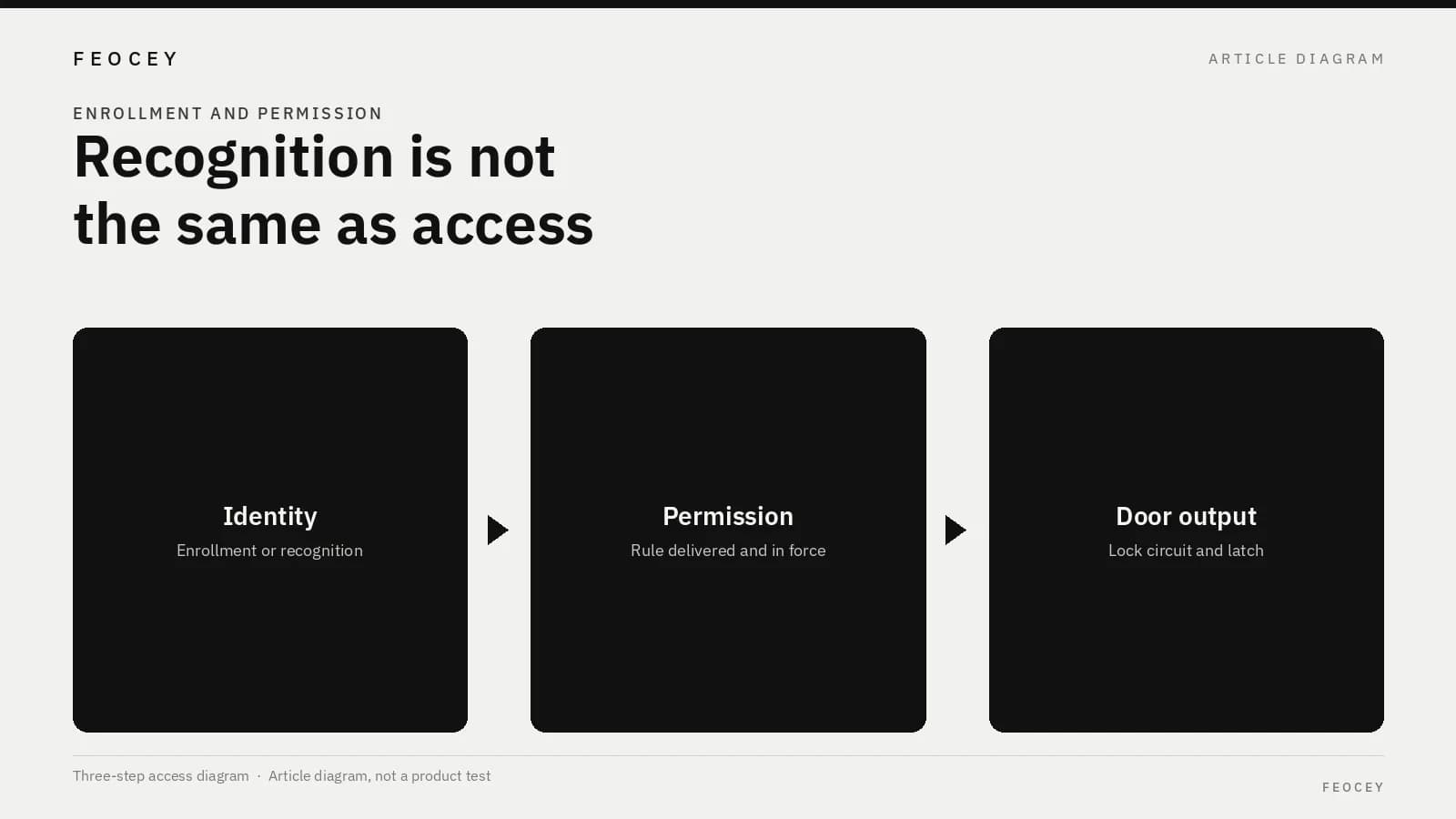
A door can refuse a person the system has already “seen,” and it can also look successful at the reader while the latch never moves. Those results are confusing only if enrollment, permission, and the physical lock circuit are treated as one event. They are not. This article is for project buyers, integrators, and software partners who need to diagnose a failed entry by asking which step actually failed. The aim is to explain the mechanism, not to walk through a purchasing checklist. A complete entry usually has to succeed in three places.
**Identity** is the enrollment and recognition step. A person or a credential is registered, and later a face, card, code, or other credential is compared with that record. A match answers only one question: did the device recognize this identity, or this credential, as one it already knows?
**Permission** is the authorization step. It answers a different question: is this recognized identity allowed to enter this opening, at this time, under the rule that is actually in force? In many systems that rule is not a single switch. The person, the credential, the target device, a schedule, and a permission group may all have to be linked, and the authorization has to be delivered successfully to the component that will use it. Feocey’s FAQ states this directly: registering a person does not necessarily grant access, because identity enrollment and access permission are separate steps in many systems.
**Physical output** is the lock-circuit step. Even a correct permission result still has to become a relay action, a powered or released lock, and a door that can move. The FCC4904 product page puts the same split in hardware language: a successful credential check may not open the door, because identity verification, access permission, and the physical control output are separate parts of the workflow. If you collapse the three steps into “the door should have opened,” you cannot tell whether the system failed to recognize someone, failed to authorize them, failed to deliver a change, or failed to move the lock.
Where each step actually lives
The component that recognizes a credential is not automatically the component that stores the permission, and neither is automatically the device that switches the lock. Reader or controller: allocating the access decision is the place to work out where the authorization check is made. The general pattern in many systems—a controller that holds a permission database—must not be assumed for every unit labeled “controller.”
In the documented Feocey arrangement for the FCC4904 four-door controller, the controller does not store permissions. Permissions are stored on the face terminal and, in some configurations, on certain card readers. Enrollment, removal, and authorization checks should be planned for those devices. The controller still organizes door circuits; it is not a reader, and it is not a permission library. That distinction matters the moment someone says “we already loaded the people on the controller.”
Delivery is part of the permission step, not a footnote. A change that exists only in a management screen has not taken effect until it has reached the device that actually stores and uses the rule. The same is true of revocation. If a person has been removed in a record but the device at the door still holds the old authorization, the door may still admit them. A network cable to a cabinet is not, by itself, proof that the permission arrived. The FAQ also distinguishes a local network connection from a connection to the management platform; those are different checks.
Schedules and groups belong to permission, not to identity. A person can be enrolled all year and still be outside the allowed hours, or allowed at one door and not at the next. The identity record can be perfect and the authorization can still be wrong.
Examples that separate the three failures
The examples below are diagnostic patterns, not project results and not a claim about a counted set of installations. You can fill in the blanks from a real door; do not invent a success rate to go with them.
**Enrolled, but not authorized.** A staff member is registered and the terminal recognizes their face. The door still denies entry because that identity was never linked to this device, this schedule, or this permission group, or because the link was never delivered. The recognition event can look like a success. The permission step is incomplete.
**Authorized in the record, but not at this opening or time.** The same person is allowed at the main entrance during working hours and is refused at a rear door, or after the schedule ends. The identity step may succeed both times. The permission step is doing what it was set up to do, which is easy to miss if the only question asked is “is this person in the system?”
**Permission granted, but the door does not move.** The device reports a granted result, yet the lock stays set because the relay did not operate, the lock has no usable supply, the timing is wrong, or the mechanical latch cannot release. The FCC4904 product page tells a qualified installer to check the operating mode, permission result, relay timing, controller output, and lock wiring against the installation instructions. That list is a reminder that the output step has its own facts.
**A change that has not arrived.** Access was withdrawn in the management record, but the person still enters, or a new permission was approved and still does not work at the door. The identity and even the intended permission may be correct. The delivery or revocation step is not complete on the device that stores the rule.
Write the door, the identity or credential, the intended rule, and the observed result. If those lines cannot be filled, the failure has not yet been described.
A compact way to read the symptom
Use one table to map an observation to the step that usually explains it. It is a reading aid, not an acceptance form and not a claim that every system presents these exact messages.
A blank cell is not a conclusion. If you cannot fill a cell, write “not shown” and keep the case open.
| What you observe | More likely step | Why this is a different failure | What to confirm |
|---|---|---|---|
| The device recognizes the person or credential, but entry is denied | Permission | Recognition only proves identity, not authorization | Whether the person, credential, target device, schedule and group are linked, and whether that authorization was delivered |
| The record shows access, but not at this door or hour | Permission | Identity can be valid while the rule for this opening is not | The intended opening, schedule and group, not only whether the person exists |
| The system reports a granted result, but the lock does not move | Physical output | A permission result is not a completed lock action | Relay timing, output, lock supply and wiring against the installation instructions |
| A withdrawn or newly added permission still does not match the door | Delivery or revocation | A change is complete only when it reaches the component that stores the rule | Where permissions are stored, and whether the change arrived there |
| The door opens after a forced or mechanical action, not after a grant | Physical output or another release path | The leaf can move without this permission path having succeeded | Whether the opening came from the authorized output, a mechanical egress device, or another release |
Mistakes that collapse the three steps
These are reasoning errors, not a report about a particular site.
- Treating a successful face match or card read as a door command.
- Treating a green lamp, a beep, or a “valid card” message as proof that a permission change has taken effect.
- Assuming that a person who is “in the system” is authorized at every door and at every hour.
- Treating the presence of a controller, or a cable into a cabinet, as proof that the permission library lives there. For FCC4904, that assumption is the wrong one.
- Closing a ticket because the lock finally moved, without asking whether identity, permission, or a mechanical bypass produced the opening.
- Inferring a complete software model from an interface label, such as treating a Wiegand or RS485 listing as a finished authorization path. The corrected reader-and-controller article makes the same point: interface compatibility does not allocate the decision.
How to judge which step failed
Ask the three questions in order, and write the answer you actually have, not the answer you expected.
First: was this identity or credential recognized? If not, the work is still in enrollment, presentation, or the credential itself. Do not spend that time redrawing the lock circuit.
Second: was this recognized identity authorized for this opening at this time, and has that authorization been delivered to the component that stores the rule? If the record and the device disagree, you are still in the permission step, including delivery and revocation.
Third: did the authorized result operate the intended output, and did the lock and the door actually move by that path? If a granted event exists and the leaf did not move, the problem is in the physical output, including timing, wiring, and lock supply. If the leaf moved by a handle, a key, or another release, that is not proof that this permission path succeeded.
Only then decide what to change. A recognition problem is not fixed by adding lock power, and an output problem is not fixed by enrolling the person again.
Limits, short answers, and what to record next
This article does not describe a single administration screen, a universal permission model, or a tested result for every firmware. It uses the public FAQ, the FCC4904 product-page workflow split, and the corrected reader-and-controller explanation as far as those sources go. It does not identify which card readers, in addition to face terminals, store permissions, and it does not provide revocation timing.
**Is a person who can be recognized already allowed to enter?** No. Enrollment and permission are separate steps in many systems. Confirm the person, credential, target device, schedule and permission group, and confirm that the authorization was delivered.
**Does a granted credential check prove that the door opened?** No. Identity verification, access permission, and the physical control output are separate. A granted result can still fail at the relay, the lock supply, or the mechanical latch.
**If a four-door controller is installed, does that controller hold the user database?** Not in the documented FCC4904 arrangement. That unit is a four-door controller for door circuits. It does not store permissions; those are stored on the face terminal and, in some configurations, on certain card readers.
**What should we write down for the next door we examine?** Record the identity or credential, the intended opening and schedule, where the permission is stored, whether the last change was delivered, the permission result, and whether the lock moved by that output. Those lines are a description of one event. They are not a completed project report.
Source references
Feocey: Reader or controller: allocating the access decision ↗Feocey: Planning access control for an office building ↗Put the guide to work
Find the reference for your model.
Compare each device with your requirements. Confirm configuration and compatibility for the complete installation.
Discuss your project ↗