
Entrance planning
Turnstile Gate Suppliers: What Belongs in a Technical Submittal?
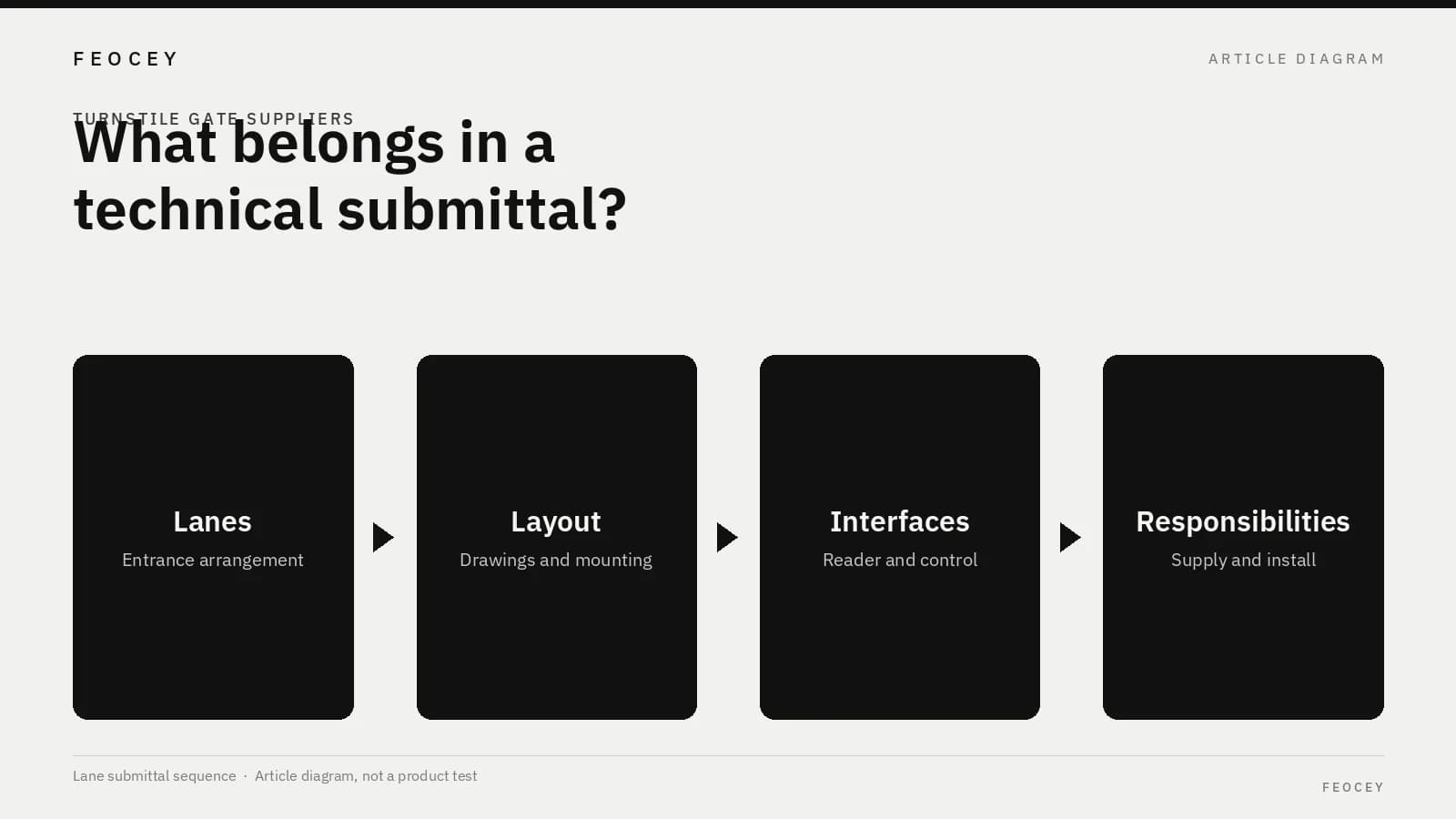
Compare turnstile suppliers with a lane-by-lane technical submittal covering layout, mounting, interfaces and responsibility—not a cabinet count alone.
Before you choose
Key takeaways.
- Compare turnstile bids with a lane-by-lane technical submittal, not a cabinet count alone.
- Request layout, mounting, interfaces, and a written supply-versus-installation split.
- A lane drawing does not certify accessibility or emergency-exit compliance; those reviews stay with the project designer.
Count lanes and define the entrance arrangement before counting cabinets
A turnstile quote that counts cabinets is not yet a comparable bid. Entrance-project buyers, MEP coordinators, and access or turnstile integrators can use this lane-by-lane technical submittal: layout, mounting, control handoff, and who supplies and installs each part.
This is procurement and coordination work. It is not a consumer wiring tutorial. Dimensions, throughput, operating modes, and code conclusions stay with the matched drawings and the project’s responsible designer. They are not filled in as Feocey capabilities.
Start with the entrance as a set of lanes, not as a product list. For each lane, record a stable ID, direction of travel, intended use (staff, visitors, accessible route, or mixed), and how that lane sits relative to adjacent lanes, walls, and queues.
Cabinet count follows from that arrangement. One cabinet may serve one lane or form part of a pair. If two suppliers quote “four cabinets” against different lane counts or different left/right assemblies, the prices are not describing the same job.
Do not treat this as a renamed door survey. A building-door checklist, such as Feocey’s four-door access control site survey, is about openings in a wall. This submittal is about lane geometry, cabinet combinations, foundations, and supplier documents. Ticket-validation rules at multiple gates are also a different problem; see QR ticket scanner multi-gate validation only if the project also has a ticketing layer.
- Give each lane a stable ID
- Record direction of travel
- Record intended use: staff, visitors, accessible route, or mixed
- Record how the lane sits relative to adjacent lanes, walls, and queues
- Note whether a cabinet serves one lane or forms part of a pair
| Field | What to record |
|---|---|
| Lane ID | A stable identifier used on every later table |
| Direction of travel | How people are intended to move through the lane |
| Intended use | Staff, visitors, accessible route, or mixed |
| Position in the entrance | Relation to adjacent lanes, walls, and queues |
| Cabinet role | One cabinet per lane, or part of a left/right pair |
Request a technical submittal, not just a product photo
Ask each supplier to submit documents that an engineer and an installer can review. A catalog image and a unit price are not enough.
Industry specifications show how some manufacturers already describe that request. A public Turnstile Security specification asks for shop drawings, gate dimensions, control rough-in, anchorage, wiring, and product data. That is that manufacturer’s specification language. It is not a Feocey drawing set, material list, or certification. See the Turnstile Security 6000 series specification.
A Gunnebo entrance-control specification (section 1.5 in the cited full-height turnstile document) asks for an equipment description, CAD layout, and installation information covering anchorage, electrical service, and cable entry. Those requirements belong to Gunnebo’s document. Do not copy its clear-width, emergency-mode, or certification statements onto a Feocey product. See the Gunnebo RotaTech full-height turnstile specification.
Use those examples only to justify asking for a complete package. Leave every measured value to the drawings that match the proposed model. If a supplier cannot yet finalize a dimension, mark it as an open item. Do not borrow a number from another brand.
- A dimensioned layout or shop drawing with the proposed cabinet combination and drawing number
- Anchorage or foundation requirements, including who designs and who installs them
- Cable-entry locations and the intended route to the control point
- Clearances needed for opening covers, replacing modules, and servicing locks or motors
| Document to request | Purpose |
|---|---|
| Dimensioned layout or shop drawing | Show the proposed cabinet combination and drawing number |
| Anchorage or foundation requirements | State who designs and who installs them |
| Cable-entry locations | Show the intended route to the control point |
| Service clearances | Cover opening, module replacement, and lock or motor service |
Reader mounting, control handoff and documented feedback
If the lane will carry a third-party or customer-specified reader, ask where it mounts, who supplies the bracket or cut-out, and which signals pass between the turnstile controls and the access system. Request the documented feedback the entrance will use (for example, passage confirmed, delayed, or blocked) without assuming a protocol until the interface is written down.
Interface pairing between a reader and a controller is a separate check. See the Wiegand reader and RS485 controller compatibility checklist when that pairing is in scope. Do not treat a matching connector as a completed turnstile handoff.
- Ask where the reader mounts
- Ask who supplies the bracket or cut-out
- Record which signals pass between the turnstile controls and the access system
- Request documented feedback, for example passage confirmed, delayed, or blocked
- Do not assume a protocol until the interface is written down
- A matching connector is not a completed turnstile handoff
| Handoff question | Project entry |
|---|---|
| Reader mounting location | — |
| Who supplies the bracket or cut-out | — |
| Signals between turnstile controls and the access system | — |
| Documented feedback to be used | — |
| Interface written down (protocol not assumed) | — |
Separate supplier and installer responsibilities
A complete-looking quote can still leave foundations, floor cutting, power, reader mounting, or commissioning unassigned. Write the split before you compare prices.
If two bids assign the same line to different parties, they are not interchangeable.
- Write the supply and installation split before comparing prices
- Foundations, floor cutting, power, reader mounting, or commissioning can still be unassigned in a complete-looking quote
- If two bids assign the same line to different parties, they are not interchangeable
| Item | Lane ID | Supplier provides | Installer provides |
|---|---|---|---|
| Cabinet / lane assembly | — | — | — |
| Reader and mounting | — | — | — |
| Foundations, anchors, floor work | — | — | — |
| Power to the lane | — | — | — |
| Control cabling and interface | — | — | — |
| Commissioning and functional tests | — | — | — |
Record other parties and open responsibility items
Use the same item list to record access-platform or other parties and any notes or open items.
Feocey publishes a turnstiles product category. That page is an entry point for discussing cabinet and lane configuration. Category-page size references are not a certified clear width, throughput rating, anti-tailgating function, or accessibility or safety approval for a specific installation. Custom or OEM supply, including how many turnstile samples follow from a cabinet and lane configuration, is discussed per project on the OEM / ODM page. That page does not promise that every enclosure or installation change will be accepted, and it does not state a fixed lead time.
- Record access-platform or other parties against the same item list
- Note open items on each line
- The turnstiles category page is an entry point for cabinet and lane configuration, not a certified clear width, throughput, anti-tailgating function, or accessibility or safety approval
- Category-page size references are not installation approvals
- OEM / ODM supply is discussed per project and does not promise every enclosure change or a fixed lead time
| Item | Lane ID | Access-platform / others | Notes / open items |
|---|---|---|---|
| Cabinet / lane assembly | — | — | — |
| Reader and mounting | — | — | — |
| Foundations, anchors, floor work | — | — | — |
| Power to the lane | — | — | — |
| Control cabling and interface | — | — | — |
| Commissioning and functional tests | — | — | — |
Compare the proposed operating and outage arrangements
Ask each supplier to describe, in writing, how the proposed lane is intended to behave in normal operation and during a power or control outage, including any option that must be selected. Record the description against the lane ID. Do not convert another manufacturer’s operating mode into a Feocey claim, and do not treat a brochure mode as a tested site condition.
A lane drawing is not an accessibility or emergency-exit approval. The project’s responsible designer and installer must review the actual entrance and the requirements that apply to it. This guide does not certify a layout. It does not transfer another manufacturer’s dimensions or operating modes to a Feocey product.
If those reviews are still pending, list them as open design items in the bid. Do not treat them as supplier defects or as completed compliance.
- Ask for a written description of normal operation and of power or control outage behavior, including options that must be selected
- Record that description against the lane ID
- Do not convert another manufacturer’s operating mode into a Feocey claim
- A lane drawing is not an accessibility or emergency-exit approval
- The responsible designer and installer must review the actual entrance and applicable requirements
- Pending reviews are open design items, not supplier defects or completed compliance
| Lane ID | Items still for the designer |
|---|---|
| L-01 | — |
| L-02 | — |
Mark options and unresolved project decisions in the bid
Options that change the lane (reader provision, finish, direction, failure behavior, or accessory rails) should be priced and drawn as options. Do not hide them inside a base cabinet count. Unresolved decisions, including final lane count, which lane is the accessible route, and who owns the floor work, should appear on both the submittal and the comparison sheet so a later choice is not mistaken for a free change.
- Price and draw options that change the lane: reader provision, finish, direction, failure behavior, or accessory rails
- Do not hide options inside a base cabinet count
- Unresolved decisions should appear on both the submittal and the comparison sheet
- Include final lane count, which lane is the accessible route, and who owns the floor work
| Decision or option | Shown on submittal | Shown on comparison sheet | Status |
|---|---|---|---|
| Reader provision | — | — | — |
| Finish | — | — | — |
| Direction | — | — | — |
| Failure behavior | — | — | — |
| Accessory rails | — | — | — |
| Final lane count | — | — | — |
| Accessible route | — | — | — |
| Floor-work owner | — | — | — |
What to send a turnstile supplier: lane layout
Send a brief the supplier can answer without guessing the entrance. Use the same lane IDs in each table. Leave width, throughput, and opening method blank until the matched drawing and the responsible designer provide them.
- Use the same lane IDs in every table sent to the supplier
- Leave width, throughput, and opening method blank until the matched drawing and the responsible designer provide them
- A catalog image and a unit price are not a complete brief
| Lane ID | Proposed cabinet combination / drawing no. | Use and direction | Service clearance |
|---|---|---|---|
| L-01 | — | — | — |
| L-02 | — | — | — |
What to send a turnstile supplier: interfaces and supply boundary
Send the interface and supply-boundary table with the same lane IDs used on the layout brief. Open design items stay on the designer list and should not be left implicit in the supplier brief.
- Record the reader mounting location for each lane
- Record the signal or control interface as a reference only, not as a completed pairing
- Record who is responsible for power and foundations
- Record the supply versus installation boundary
| Lane ID | Reader mounting location | Signal / control interface (reference only) | Power and foundation responsibility | Supply vs installation boundary |
|---|---|---|---|---|
| L-01 | — | — | — | — |
| L-02 | — | — | — | — |
Common questions
These short answers restate what a quotation should include, and what a lane drawing does not certify.
- A turnstile quotation should be accompanied by layout, product and installation references, mounting and cable-entry information, and a defined control interface, with equipment supply separated from foundations, cabling, reader mounting, and commissioning.
- A lane drawing does not establish accessibility or emergency-exit compliance.
| Question | Answer |
|---|---|
| What should accompany a turnstile quotation? | Request the proposed lane layout, product and installation references, mounting and cable-entry information, and the defined control interface. Separate the equipment supplied from foundations, cabling, reader mounting, and commissioning responsibilities. |
| Does a lane drawing establish accessibility or emergency-exit compliance? | No. The responsible project designer and installer must review the actual entrance and applicable requirements. This procurement guide does not certify a design or transfer another manufacturer’s dimensions or operating modes to a Feocey product. |
Source references
Feocey four-door access control site survey checklist ↗Feocey Wiegand / RS485 compatibility checklist ↗Put the guide to work
Find the reference for your model.
Compare each device with your requirements. Confirm configuration and compatibility for the complete installation.
Discuss your project ↗