
Selection & Applications
Single Door Controller or Four-Door Panel: What Should the Bid Specify?
A single door controller is not the same as a standalone system. Specify door count, reader ports, lock outputs, the host link, and how the system will be administered.
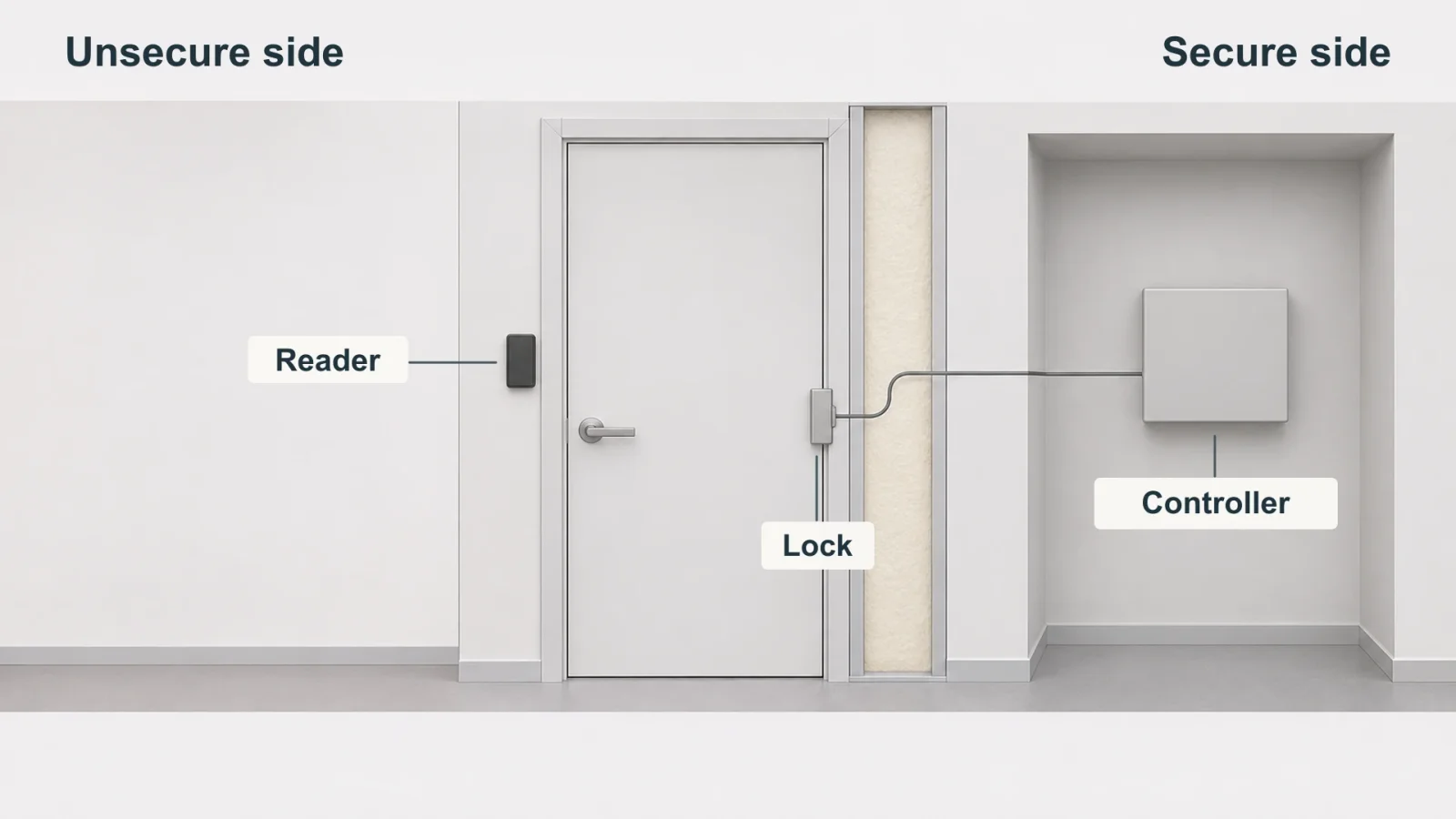
Before you choose
Key takeaways.
- Specify the number of controlled openings and readers separately. The FCC4901/FCC4904 family specification lists one and four door outputs, and two and four readers, respectively.
- Ask each bidder to identify where credentials are managed and how the system records events while the host is offline.
- Compare quotations using actual cable routes, lock-power requirements and a door-by-door equipment schedule.
A bid that names a “single door controller,” a “four-door panel,” or a “standalone door” is naming three different requirements. A single door controller is a circuit count: how many lock outputs and reader ports the hardware presents. A four-door panel is also a circuit count, and it still depends on cable routes. In supplier language, “standalone” may mean local administration, or it may mean only an isolated opening. Write how the system is administered and what happens if the host link drops. Do not infer “no central software” from the word alone.
This article is a bid-specification checklist for that choice. It uses Feocey’s FCC4901 Single-Door Access Controller and FCC4904 4-Door Access Controller as a worked example of what a published product page actually settles — and what still has to be written into the request for quotation (RFQ). The question is not “which product is better.” It is “which facts belong in the bid before anyone prices the panel.”
What a single door controller is — and what the name does not settle
In access-control hardware, a single door controller presents the circuits for one opening. The lock output serves the opening, while the reader count tells you how many credential-reading points the manufacturer supports. An entrance with a reader on each side is still one opening. The name alone does not tell you where permissions are stored or how the system is administered.
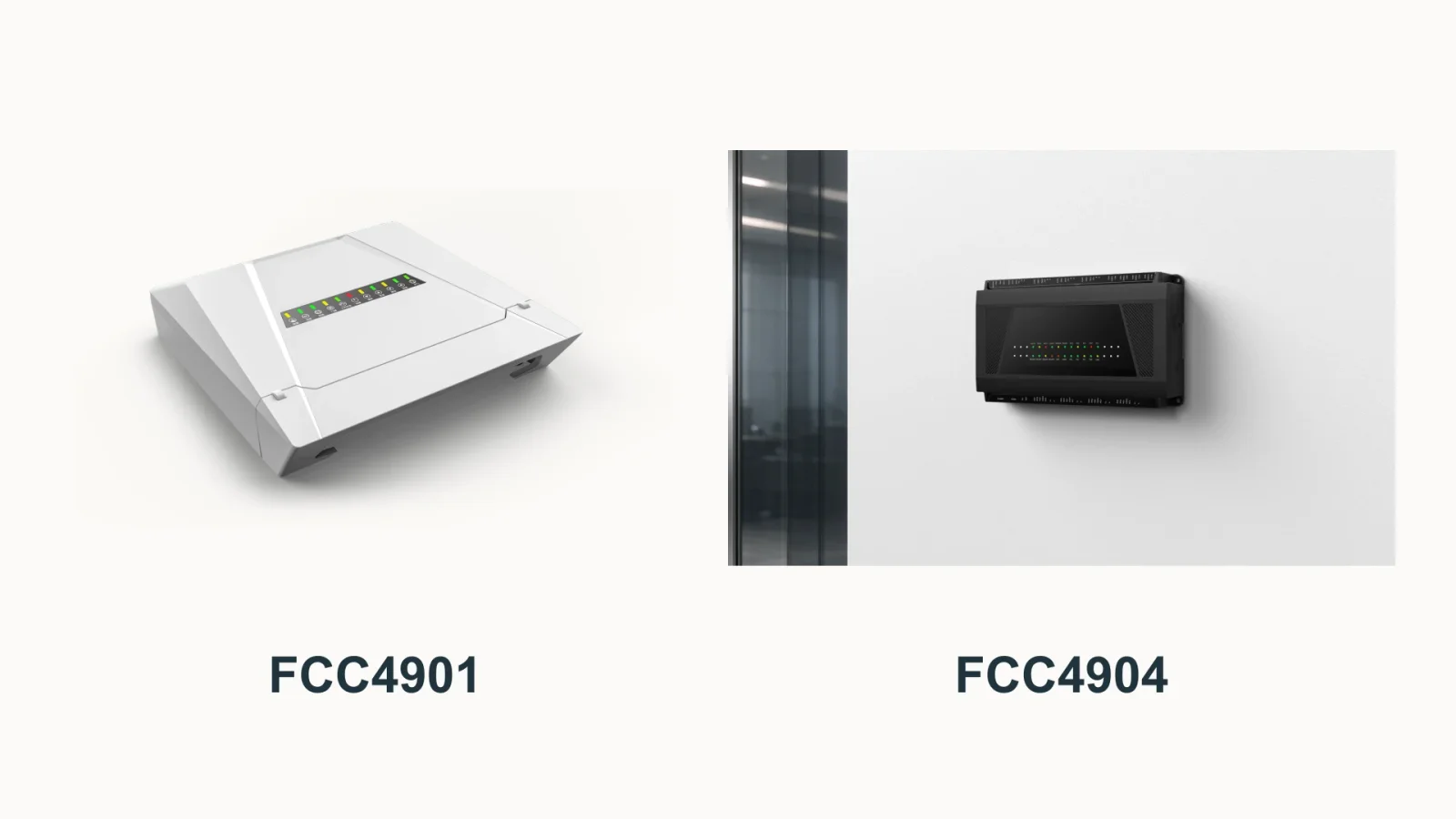
Feocey’s published example follows the same split. The shared family specification lists controllable gate outputs as 1 on the single-door unit and 4 on the four-door unit, and card readers that can be connected as 2 and 4 respectively (FCC4901 / FCC4904 specification PDF). On the product pages, FCC4901 is named a Single-Door Access Controller; FCC4904 is named a 4-Door Access Controller and is described as supporting four door connections. Reader input is listed as RS485 at 115200 baud. Family-level communication is listed as TCP/IP, UDP, MQTT, and RS485.
None of those published facts settles whether the controller stores permissions locally, whether it can be administered without a host, or what happens if the network link drops. Those are “standalone” and host-link questions. They belong in the bid as written behavior, not as an assumption drawn from the product name.
The earlier Feocey article Reader or Controller: Allocating the Access Decision explains why the location of the access decision has to be confirmed for the selected configuration. In the FCC4904 arrangement described there, permissions reside on the face terminal or a supported reader. The four-door panel brings the door circuits together. Ask who approves a credential and who manages its permissions before the layout is priced. Those two choices still have to be written into the bid.
Three questions the bid should separate
Before the panel is priced, separate the requirement into three questions. They look similar in a product name. They are not interchangeable in a specification.
| Bid term | Typical meaning | What the bid should still specify | What actually proves it |
|---|---|---|---|
| Single-door / four-door | Door-circuit count: lock outputs and reader ports on the panel. | Number of lock outputs, number of reader ports, and which inputs are included. | The product page or specification for the exact model, plus a wiring drawing for the openings on this site. |
| Standalone / offline | In supplier language, may mean local administration, or only an isolated opening. | How the system is administered, and what happens if the host link drops. | A witnessed host-down and recovery test against the agreed written behavior. |
| “Controller” in the product name | A device that presents door circuits. The selected system design determines where permissions are evaluated. | Where permissions are stored, and whether a host is required for enrollment or event upload. | A written administration model, not the word “controller” in the product name. |
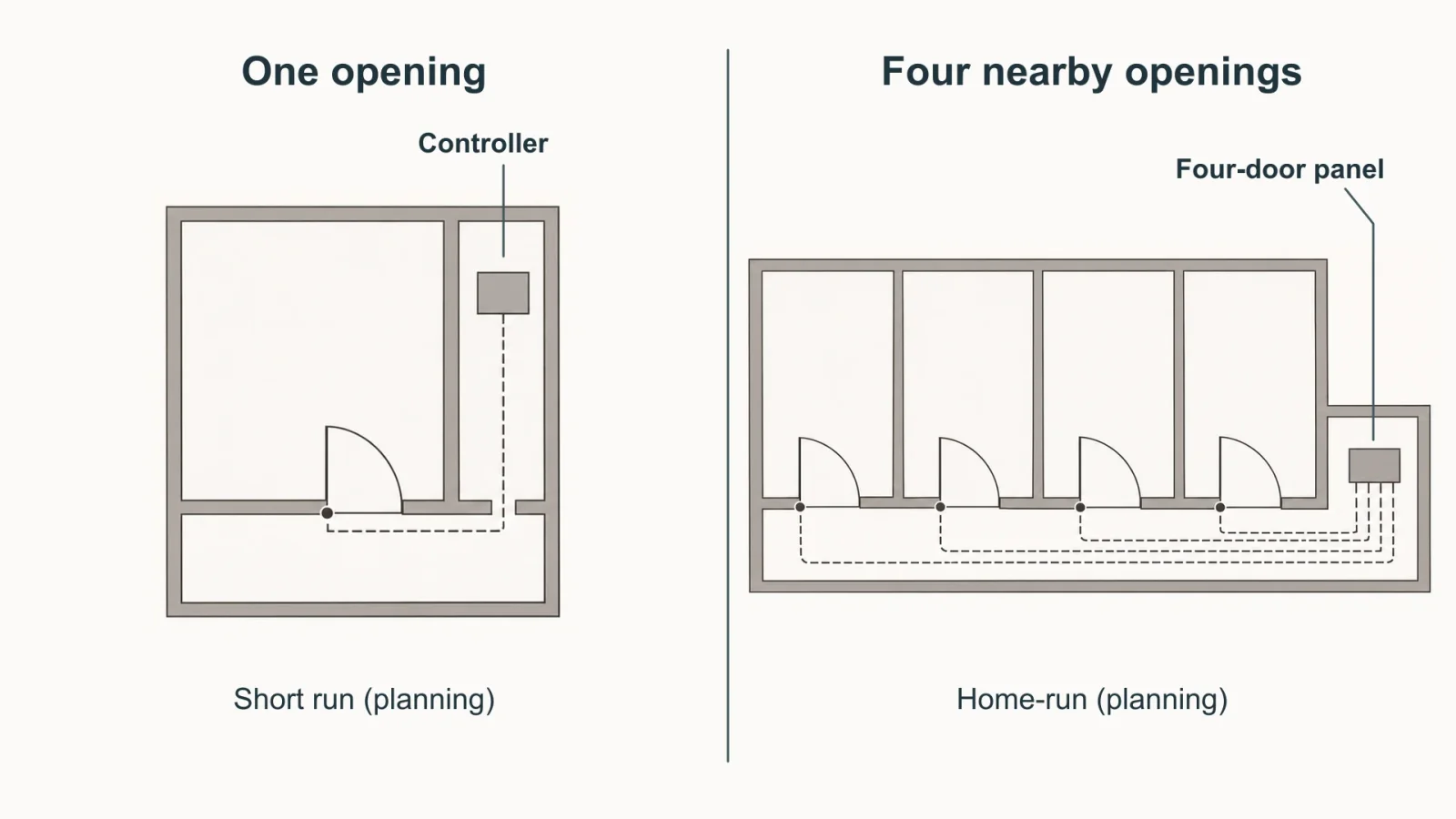
Four-door is a circuit count, not a site layout
“Four-door” means the panel presents four door circuits. It does not mean four doors on a floor can always share one panel. Cable length, lock power, fire-interface routing, and whether the doors are close enough to home-run to one location still have to be surveyed. A four-door panel in a distant riser can cost more in cable and commissioning than four local single-door controllers. In a discussion of panel placement, installers describe how cable routes and future service access change their preference. Ask bidders to mark the routes they priced. The earlier Feocey article Access Control System Cost: What a “Per-Door” Quote Really Includes is the right place to take that cost question next; this article stays with what the bid must specify.
“Standalone” must be defined in writing
In supplier language, “standalone” may mean local administration, or it may mean only an isolated opening. It is not a door count, and the word alone does not mean that no central software is required. Write how the system is administered and what happens if the host link drops.
A one-door controller can still depend on a host for enrollment, schedules, or event upload. For each function, ask the bidder to name the device or service that performs it. If the site needs local administration, ask the bidder to demonstrate changing a test credential with the host unavailable.
Consider an outbuilding with one controlled opening. Purchasing might call it a standalone door because it is physically isolated, while IT expects to administer its permissions centrally. Write both expectations into the RFQ so the installer and the software partner price the same work.
UC San Diego’s commissioning requirements ask the integrator to verify that authorized-user records and door schedules are available locally during a network outage. Make the host-down requirement measurable. For example, ask the bidder to demonstrate what happens to two test badges with different schedules during an agreed outage. After reconnection, have an operator find both events in the host log and check their original timestamps. Specify any required recovery time and name the person who signs off. This is a proposed acceptance test for the project.
What to write in the RFQ
Use the table below as a fill-in checklist. The right-hand column is the evidence that should come back with the quotation — not a promise inferred from a product name.
| Write this in the RFQ | Why it matters | What to request with the quotation |
|---|---|---|
| Door-circuit count | “Single-door” and “four-door” are hardware counts, not a site plan. | Lock-output count, reader-port count, and a door-by-door assignment for this site. |
| Reader ports and reader protocol | A port count is not a compatibility list. | The reader protocol document for the selected model and firmware, and written confirmation for each reader type. |
| Lock outputs and power | The panel rating is not the same as the lock load. | Lock-output type, the supporting supply rating, and whether lock power is supplied by the panel or separately. |
| Inputs that must be present | Door contacts, exit buttons, and fire or tamper inputs are not implied by a door count. | A per-model input list, not a family-level assumption. |
| Standalone / host-down behavior | In supplier language, “standalone” may mean local administration, or only an isolated opening. | A written administration model and an offline test. Do not infer the behavior from the word “standalone.” |
| Network and integration path | Family-level protocol names are not a project interface. | The protocol document for the selected model and firmware, and the host or software required. |
| Installation location and cable routes | A four-door panel only stays economical if the doors can actually home-run to it. | A riser or enclosure location, and cable lengths for each opening. |
| Certifications that apply to the supplied model | Marks published for one model in a family do not automatically apply to the other. | The certificate or test report for the exact model being supplied. |
On the Feocey family page, those rows resolve unevenly, which is exactly why the bid should ask for them one by one. The shared specification gives the 1-and-4 gate-output split and the 2-and-4 reader-port split. Supporting supply is listed as 12VDC 5A. Reader input is listed as RS485 at 115200 baud. Family communication is listed as TCP/IP, UDP, MQTT, and RS485.
Some facts are published only for FCC4904 and should not be copied onto FCC4901. The 4-Door unit is described as having four lock connections with relay outputs and door-contact inputs, four RS485 reader ports, and four exit-button inputs, plus fire-alarm and tamper inputs. Its product page tells installers to use one of two 12 V power inputs and to use an external 12 V supply. CE (EMC) and FCC Part 15B are published on the FCC4904 product page; they are not stated on the FCC4901 page, so they should not be assumed for the single-door unit. Use the FCC4904 port reference to check the input list and the FCC4904 wiring guide to confirm the proposed power connections.
Family-level communication is listed as TCP/IP, UDP, MQTT, and RS485, and Feocey publishes an MQTT integration path under Open API. Treat that path as model- and firmware-specific. Request the protocol document for the selected model and firmware (Open API, FCC4901). For FCC4901, request the specification and wiring documents that match the supplied configuration. Do not assume a reader is compatible from the RS485 interface alone, and do not assume a REST API for door-strike control — Feocey does not publish one.
When a dedicated single-door controller is the cleaner choice
A dedicated single-door controller is usually the cleaner specification when at least one of the following is true:
- The opening is isolated — a remote gate house, a single stair door, or a door that cannot share a riser with other controlled openings.
- The cable route to a four-door panel would be long, expensive, or hard to commission, so a local panel reduces risk even if the hardware price looks higher.
- The owner wants a one-door failure domain: work on one opening should not take a multi-door panel offline.
In those cases, write the door-circuit count as one, then still write the administration model, the reader protocol, and the lock-power arrangement. “Single door” does not fill in those rows.
When a four-door panel is the cleaner choice
A four-door panel is usually the cleaner specification when the doors are close enough to home-run to one secure location, and when one enclosure, one power arrangement, and one commissioning visit are genuinely cheaper than four local panels. That is a survey result, not a default.
Use the earlier Feocey checklist Four-Door Access Control Site Survey Checklist to test that assumption on the floor: door locations, cable routes, lock power, and the fire interface. If the survey cannot show a clean home-run, specify single-door controllers for the scattered openings and keep the four-door panel only where the doors actually cluster.
What to confirm with the platform partner before the bid is released
Two product facts should be confirmed in writing with the platform partner, because they are easy to over-read from a catalog:
- Feocey does not offer an OSDP controller. If the bid assumes OSDP readers, that assumption will not be met by these models.
- RS485 on the controller is an interface, not a compatibility list. Each reader type still needs written confirmation.
Those confirmations belong in the RFQ packet, next to the protocol document for the selected model and firmware.
Limits and short answers
This article compares published door-circuit counts and the bid language they require. It does not recommend one Feocey model as universally better, and it does not treat family-level figures as a complete specification for both units. User-capacity and chassis-size figures that appear in the shared family table are omitted here because the official English product pages do not resolve the units. Input lists, power wiring, and certifications published only for FCC4904 are not assumed for FCC4901.
Is a single door controller the same as a standalone system?
No. A single door controller is a circuit count: typically the lock outputs and reader ports for one opening. In supplier language, “standalone” may mean local administration, or only an isolated opening. Write both requirements separately. A one-door controller can still depend on a host; a four-door panel can still be administered locally.
Does a “standalone door controller” mean there is no software?
No. In supplier language, “standalone” may mean local administration, or only an isolated opening. It is not a door count, and the word alone does not mean that no central software is required. Where a bid calls for local administration, require a demonstration on the selected configuration. A one-door controller can still depend on a host. Write the administration model and the host-down behavior. Ask for a witnessed test covering the agreed schedules, local behavior during a host outage and delivery of records after reconnection.
Can four nearby doors always share one four-door panel?
No. “Four-door” is the number of door circuits on the panel, not a guarantee that four doors on a floor can share it. Confirm cable routes, lock power, and the fire interface on site. If the doors cannot home-run cleanly, a local single-door controller is often the cleaner specification for the scattered openings.
If the RFQ now has a door-circuit count, a reader-port and protocol request, a lock-power arrangement, a per-model input list, and a written administration and host-down test, the specification is complete enough to price. If any of those rows is still being inferred from the words “single door,” “four-door,” or “standalone,” write that row before the bid goes out.
If you are writing the RFQ this week, use the two tables above as the checklist. Confirm door-circuit count, reader ports, lock power, the input list, and the administration model in writing before the bid is priced.
References
- FCC4901 / FCC4904 specification PDF
- discussion of panel placement
- UC San Diego’s commissioning requirements
- Feocey FCC4904 port reference — lock, reader and input connections
- Feocey FCC4904 wiring guide — power supply and door connections
- Feocey — Reader or Controller: Allocating the Access Decision
- Feocey — Four-Door Access Control Site Survey Checklist
Put the guide to work
Find the reference for your model.
Compare each device with your requirements. Confirm configuration and compatibility for the complete installation.
FCC4901 →
Access controller
Ask about FCC4901 ↗FCC4904 →
Access controller
Ask about FCC4904 ↗