
Hardware procurement
Access Control Hardware Lifecycle: Questions to Ask Before Ordering
Ask access hardware suppliers about end-of-sale notices, support scope, spare parts and replacement compatibility before committing to a rollout.
Before you choose
Key takeaways.
- Split new-order availability, firmware or software maintenance, technical assistance, repair or spares, and any successor model before you read a “support” sentence.
- Ask for written milestones, notice owners, and named documents; do not fill years or fees into the schedule without a supplier source.
- Treat a recommended replacement as a configuration change that still needs mechanical, harness, credential, and software checks.
Separate sale availability, maintenance and repair support
A factory acceptance test and a warranty statement alone do not describe how long a reader or terminal can be bought, maintained, repaired, or replaced. Multi-site buyers, integrators, and OEM or ODM partners can use this written question set before a purchase order: end-of-sale notice, support scope, spare parts, replacement models, and who is accountable for each item.
No duration, stock level, or response time is filled in here. Those answers have to come from the supplier, in writing, for the exact hardware and software you plan to deploy. This is not a Feocey lifecycle policy.
The word “support” can cover several different things. Split them before you read a policy:
End of sale and end of support are not necessarily the same event. A product can stop being sold and still have a defined maintenance or repair period, or the reverse can be unclear if the policy never separates the terms. Do not infer the whole picture from a warranty label. A warranty describes what happens if a unit fails during a stated period. It does not, by itself, say when new orders stop, who will receive a discontinuation notice, or whether a spare will still exist after that notice.
Vendor policies illustrate the split. They are not industry rules, and they are not Feocey terms. HID’s published Readers and Encoders Product Support Life Cycle distinguishes general availability, end of sales, and end of life, and it discusses sustaining engineering, technical support, and warranty or repair under those phases. That policy describes HID’s own readers. See HID Readers and Encoders Product Support Life Cycle.
Axis Communications publishes a general support policy after a discontinuation date. The published page lists discontinuation, end of hardware support, post end of support, technical services support, self-help resources, and a recommended product replacement as separate items. Use it as another example of why the questions should be asked separately. Do not copy Axis periods, fees, or replacement rules into a Feocey quote or treat them as a market standard. See Axis general support policy after discontinuation date.
When you read any vendor policy, including these examples, list the phase names the document actually uses, then map your questions onto those names. Ask the supplier bidding your project to point to the document that applies to your models. Do not import another vendor’s periods or fees into your RFQ, and do not treat a competitor policy as a Feocey commitment.
- Whether the model is still offered for new orders
- Whether firmware or software maintenance continues, including security fixes
- Whether technical assistance continues
- Whether repair, return merchandise authorization, or spare parts remain available
- Whether a successor model is identified, and what still has to be checked before you adopt it
Ask for the lifecycle milestones in writing
Request a milestone list for each model and major software or firmware branch in the bill of materials. A family name on a brochure is not precise enough if two option sets or two firmware branches have different remaining lives.
Ask who issues the notice, how it is delivered, and who at your organization is supposed to receive it. Ask whether a final-order window exists, and how last-buy quantities are handled. Ask which firmware or application versions remain eligible for maintenance after a sale milestone, and how you will be told that a version is no longer maintained.
If the supplier cannot name an owner or a notice method, record that as an open risk. Do not fill the gap with an assumed number of years. A fillable notice line can be as simple as: model or configuration ____; document cited ____; notice owner at the supplier ____; delivery method ____; recipient role on the buyer side ____; final-order rule, if any ____. Complete it from the supplier’s written answer, not from a catalog headline.
If you standardize one reader across several sites, decide in advance who consolidates a last-time buy and who is allowed to accept a mixed population when a successor appears at only some doors. Those are project decisions. They are not implied by a warranty sentence.
Define what support actually includes
“We will support it” is not a scope. Ask what is included, what is excluded, and whether any item is sold as a separate contract.
Work through at least these lines:
Ask for the document that the supplier will point to later (policy, contract exhibit, or written exception). If the only answer is a verbal assurance, write that down too. A verbal “we usually keep parts around” is not a spare-parts commitment.
If support is split among a manufacturer, a regional distributor, and an integrator, write the split against each line above. Otherwise a firmware question can bounce from the installer to a portal that only answers in-warranty hardware, while a failed spare request goes back to the installer.
- Security or corrective firmware updates: which versions qualify, and what is explicitly out of scope
- Application or host compatibility: whether a later platform version is reviewed against the frozen hardware, or whether that work is the integrator’s
- Repair or replacement of failed units, including any RMA path
- Spare modules, readers, or complete units: whether they are expected to be available, and who holds that obligation
- Who pays for what, including freight, advanced replacement, or out-of-scope repairs, without inventing a fee schedule in the RFQ
Plan for a replacement without assuming a drop-in swap
When a model is withdrawn, a “recommended replacement” is a starting point. It is not a completed design change.
Review, at least:
Treat the alternative model as a configuration change that needs the relevant checks. Related field practice for recording firmware and wiring after a change is covered in Documenting firmware and wiring for repeat installations. Interface and power questions at the time of first order remain in Access terminal integration questions before ordering. This guide does not repeat those how-to records. It asks who will still answer them years after the first delivery.
If a site later mixes the original model and a successor on the same controller or door schedule, record who is responsible for proving that both still meet the accepted behavior. Do not assume that a similar faceplate means the same output format, power draw, or enrollment data.
- Mechanical fit: enclosure, mounting, and any pedestal or recess
- Harness and power: connectors, supply requirements, and cable lengths already installed
- Credential behavior: whether the same card, QR, or face enrollment still behaves as specified on the new unit
- Firmware and the accepted host or software reference, including any configuration that must be rebuilt
Assign responsibilities across manufacturer, integrator and platform partner
Lifecycle work can be split until no one owns the gap. Write the expected owner for notices, firmware publication, on-site replacement, spare stocking, and host retesting. If the manufacturer issues a bulletin but the integrator is the only party your sites will call, say so in the purchase scope.
Name a buyer-side owner as well. A supplier notice that arrives in a generic mailbox, with no one assigned to read it, is not a managed milestone. Say who will review a successor proposal, who can approve a last-time buy, and who updates the accepted configuration record.
Feocey’s OEM / ODM page states that project scope, configuration, and lead time are confirmed per project, which makes it a reasonable place to discuss supplier-side scope. It does not publish a unified end-of-life, patch, spare, or SLA period. The support page is a current after-sales entry point. The existence of that entry is not a long-term product-lifecycle commitment.
Use a lifecycle-response schedule before the purchase order
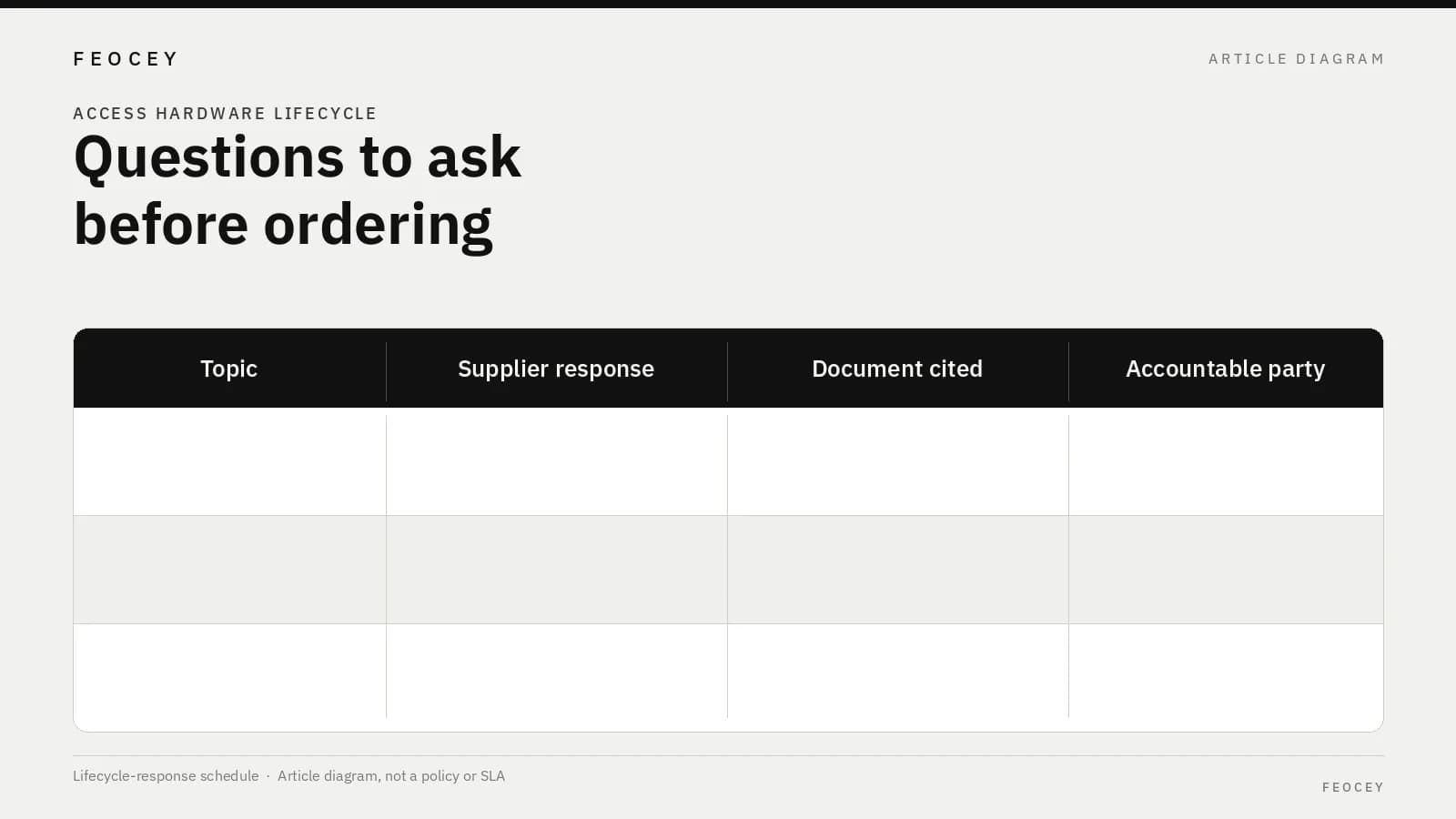
Ask each supplier to complete this schedule for every model you intend to standardize. Leave durations blank until the supplier fills them from a named document. If a cell cannot be completed, write “not stated” or “out of scope” and name the residual owner. A blank cell is not a decision.
Do not pre-fill years, stock quantities, or fees to make the schedule look complete. The point of the sheet is to show what the supplier has actually stated.
| Topic | Supplier response | Document or exception cited | Accountable party | Open item? |
|---|---|---|---|---|
| New-order availability / end-of-sale milestone | — | — | — | — |
| Notice owner, method, and recipients | — | — | — | — |
| Final-order window, if any | — | — | — | — |
| Last firmware or application versions maintained | — | — | — | — |
| Security or corrective-fix scope | — | — | — | — |
| Technical assistance after sale ends | — | — | — | — |
| Repair / RMA path | — | — | — | — |
| Spare or replacement-unit availability | — | — | — | — |
| Cost responsibility (as stated by the supplier) | — | — | — | — |
| Recommended successor model, if any | — | — | — | — |
| Differences still to check (mount, harness, credentials, software) | — | — | — | — |
Common mistakes, short answers, and the next project step
The items below are planning errors, not a claim about a specific supplier or a completed Feocey policy.
**Are end of sale and end of support the same thing?** Not necessarily. Supplier policies can distinguish product availability, maintenance updates, technical assistance, and repair. Ask for the milestones and service scope for the exact hardware and software. Do not infer them from a warranty label.
**Does a recommended replacement automatically fit the old installation?** No. Review mechanical fit, harness and supply, credential behavior, firmware, and host compatibility. Treat an alternative model as a configuration change requiring the relevant checks. It is not a guaranteed drop-in replacement.
**Can this schedule be used if the hardware is custom or configured per project?** Yes. That is a reason to ask the questions against the exact configuration, not only a family name. A per-project scope still needs a named notice method, a support definition, and a replacement-check list.
**What should we send next?** Send the blank schedule with the bill of materials and ask each supplier to complete it from a named document. Keep open items visible until someone accepts the residual risk. Do not treat a sales conversation as a substitute for those written answers.
- Treating a warranty sentence as a complete end-of-sale, patch, spare, and replacement plan
- Filling years or fees into the schedule without a named supplier document
- Assuming a recommended replacement is a drop-in swap
- Leaving the notice recipient and last-buy owner unnamed
- Using one “support included” checkbox for maintenance, technical assistance, and repair
- Copying another vendor’s lifecycle periods into a different supplier’s quote
Source references
Feocey documenting firmware and wiring for repeat installations ↗Feocey access terminal integration questions before ordering ↗Put the guide to work
Find the reference for your model.
Compare each device with your requirements. Confirm configuration and compatibility for the complete installation.
Discuss your project ↗