

How to Choose Face Recognition Devices: A Complete Guide for 2025
Facial recognition devices have become indispensable tools for businesses worldwide—from securing office buildings and streamlining employee attendance to enabling seamless payments and enhancing customer experiences. But with a flood of options on the market, selecting the right device for your needs can feel overwhelming. Choose poorly, and you risk security gaps, user frustration, or costly integration headaches.
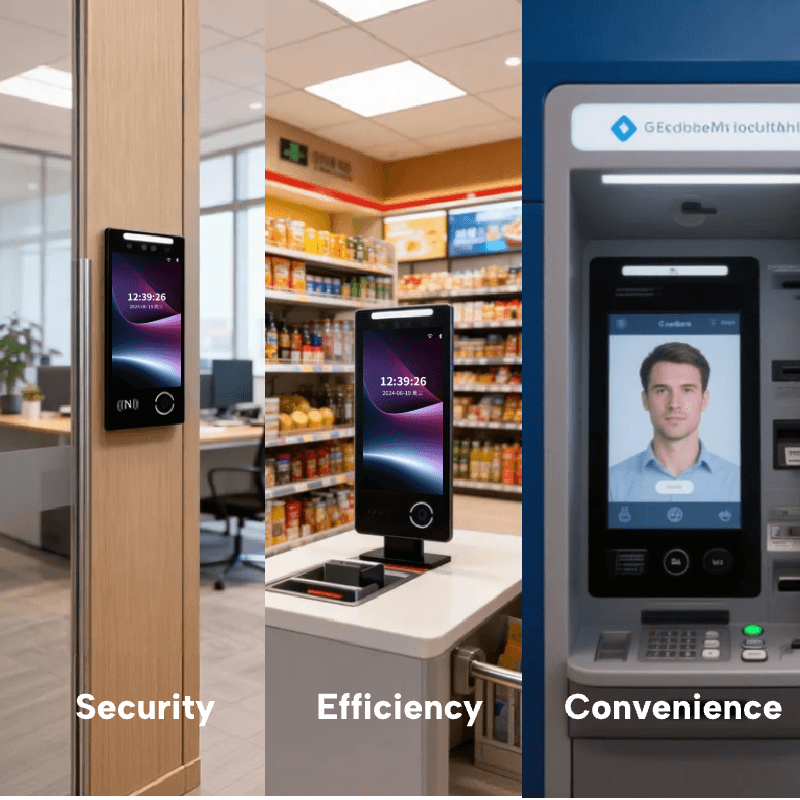
Key Factors to Consider When Choosing Face Recognition Devices
1. Accuracy & Reliability: The Foundation of Trust
Accuracy is non-negotiable for face recognition devices—any misidentification can lead to security breaches or user dissatisfaction. Two key metrics define accuracy:
– False Acceptance Rate (FAR): The chance of unauthorized users being granted access (e.g., a stranger passing as an employee). Look for a low FAR (ideally 0.0001% or lower) for high-security needs like banking.
– False Rejection Rate (FRR): The chance of legitimate users being denied access (e.g., an employee unable to enter the office). A low FRR (under 1%) ensures a smooth user experience.
Reliable devices balance these two rates and provide transparent benchmark results from reputable tests like NIST FRVT. For example, devices using 3D structured light technology offer higher accuracy than monocular cameras, making them ideal for financial services or high-security areas.
2. Hardware Quality: Cameras & Anti-Spoofing Capabilities
The physical components of the device directly impact performance—especially the camera and liveness detection features.
– Camera Performance: Opt for cameras with multispectral imaging to handle extreme lighting (bright sunlight, low light) and portrait orientation to avoid fish-eye distortion. Ensure the field of view is wide enough to capture users of all heights, including wheelchair users (ADA compliant).
– Liveness Detection: Advanced Presentation Attack Detection (PAD) is a must to prevent fraud. Look for devices that detect 3D masks, printed photos, or digital screens and comply with the ISO 30107-3 standard.
– Durability: For outdoor or high-traffic use, choose devices with weatherproofing (IP65 rating) and resistance to dust, temperature changes, and electromagnetic interference.
3. Speed & Performance: Keep Workflows Smooth
Slow devices disrupt operations—whether it’s long lines at a retail checkout or bottlenecks at office entrances. Evaluate three key speed metrics:
– Detection Speed: How quickly the device identifies a face in a video stream (aim for <0.3 seconds for real-time use).
– Verification Speed: Time to match a face to a stored template (1:1 matching, ideal for access control: <1 second).
– Identification Speed: Time to search a face against a large database (1:N matching, for public safety or enterprise use: <3 seconds for 1 million users).
Edge computing-enabled devices process data locally, offering faster speeds and lower latency than cloud-dependent models—perfect for time-sensitive applications.
4. Integration Flexibility: Fit With Your Existing Systems
A great face recognition device should work seamlessly with your current tech stack, not against it.
– Compatibility: Check support for your operating systems (Windows, Linux, Android, iOS) and programming languages (Python, C++, Java, C#).
– APIs & SDKs: Look for well-documented APIs or SDKs that simplify integration with HRMS software, access control systems, or self-service kiosks.
– Deployment Options: Choose between cloud (scalable, remote access), on-premises (full data control), or hybrid models based on your security needs and infrastructure.
5. Security & Compliance: Protect Sensitive Data
Facial biometrics are highly sensitive—your device must meet global privacy standards and protect against cyber threats.
– Data Protection: Ensure the device encrypts data at rest and in transit. Look for security certifications like ISO/IEC 27001 or SOC 2.
– Regulatory Compliance: Verify compliance with GDPR (EU), CCPA (California), KYC, and AML regulations to avoid legal risks.
– Data Storage: Choose devices that let you control where biometric data is stored (local vs. cloud) to align with your privacy policies.
6. Scalability: Grow With Your Business
Your needs today won’t be the same tomorrow—select a device that scales without sacrificing performance.
– Database Capacity: Ensure the device can handle growing user bases (e.g., from 100 to 10,000+ users) without slowing down.
– Multi-Site Support: For businesses with multiple locations, look for devices that sync data across sites and support centralized management.
– Auto-Scaling: Cloud-integrated devices should automatically adjust resources during peak times (e.g., morning office rush hours).
7. Cost Transparency: Avoid Hidden Fees
The total cost of ownership (TCO) goes beyond the initial purchase price. Consider:
– Upfront Costs: Hardware purchase, installation, and setup fees.
– Ongoing Costs: Subscription plans, software updates, maintenance, and technical support.
– Scalability Costs: Fees for adding more users, features, or integration with additional systems.
8. Vendor Support & Reliability
A quality device is only as good as the support behind it.
– Support Availability: Look for 24/7 support if your device operates around the clock (e.g., retail, healthcare).
– Response Time: Check SLAs for issue resolution (aim for <4 hours for critical problems).
– Documentation & Resources: Choose vendors with detailed manuals, tutorials, and a knowledge base to help your team troubleshoot independently.
– Vendor Staying Power: Opt for providers with a proven track record (5+ years in the industry) to ensure long-term product support and updates.
Industry-Specific Considerations
Different industries have unique needs—tailor your choice accordingly:
– Banking/Fintech: Prioritize 3D structured light cameras, low FAR, and AML/KYC compliance.
– Retail: Focus on fast verification speed, queue management, and integration with POS systems.
– Office/Access Control: Look for ADA-compliant cameras, offline functionality, and HRMS integration.
– Healthcare: Emphasize data privacy (HIPAA compliance), durability, and hands-free operation.
Conclusion
Choosing the right face recognition device is a strategic decision that balances security, user experience, and cost. By focusing on accuracy, hardware quality, integration, and compliance, you can select a device that solves your specific pain points—whether it’s reducing fraud, streamlining workflows, or enhancing safety.
Remember, there’s no one-size-fits-all solution. Test devices in your actual environment, ask vendors detailed questions, and prioritize long-term value over short-term savings. With the right device, you’ll unlock the full potential of facial recognition technology for your business.